When I was a child growing up in Wauwatosa, we had four elderly siblings living next door. Every holiday season, Miss Jesse and Miss Belle would get busy in the kitchen and then show up at our front door with a plate of fudge. My oh my, what extraordinary fudge it was. It was the nirvana of fudge. The crystallization was so perfect that a piece would simply explode in your mouth with fudgy goodness. The sisters made certain that there were precisely the same number of pieces for each member of the family, so it was one of the few things that my siblings and I never fought about at Christmas.
It never occurred to anyone in my family to learn their secrets. Mom didn’t enjoy cooking, and us kids were rarely allowed near the stove except to stir something in a pinch. But this magic must have been in Jesse and Belle’s family for a very long time. It had undoubtedly been handed down the female side of their family for generations. Alas, they were childless and as far as I know both the recipe and the method went to the grave with them.
It was some years later that I took it upon myself to recreate the experience. I started with literally nothing to go on. No cherished family fudge recipe had been bequeathed to me. Worse yet, I had no experience with candying. It must be distinctly understood that an understanding of the chemistry of crystallization was essential. So where to begin? This was before the availability and ubiquity of the internet, so naturally my starting point was Irma Rombauer’s “The Joy of Cooking.”
To begin with, I read all the “About This’s” and all the “About That’s” (Ah, I can tell that you are familiar with “Joy” yourself!). Then I set to work. My first try was less than stellar. In fact, it was monumentally bad. The overall effect was that of scorched chocolate fused to charred sugar. But not to be deterred, I tried again. And again. And again. And again. I wasn’t getting anywhere. To be clear, I certainly wasn’t getting any better.
At first, I assumed that I had a bogus candy thermometer, so I bought a new one. No difference. Just to double check, I did the boiling water test. There was nothing wrong with the thermometer. I tried changing the recipe. I tried changing the parameters. Every now and again I would get a batch that was reasonably edible, but that was rare. This went on for years.
While my children were young, there was a joke that circulated the family. “If it’s Christmas, beware of low flying saucepans.” The joke was well deserved. During those years, I was famous…no, I was infamous for my hockey puck fudge, for that was the consistency I was getting on a regular basis. I went through saucepans the way active women go through panty hose. My notoriety extended to the housewares department at Target where, at least twice a Christmas, I had to replace a saucepan. I was a sad, if comic, figure in aisle 7. “Another failure, dear?” I mean, how difficult could this be? I wasn’t attempting to launch a rocket for goodness’ sake. Was being able to create an actual batch of edible fudge too much to ask?
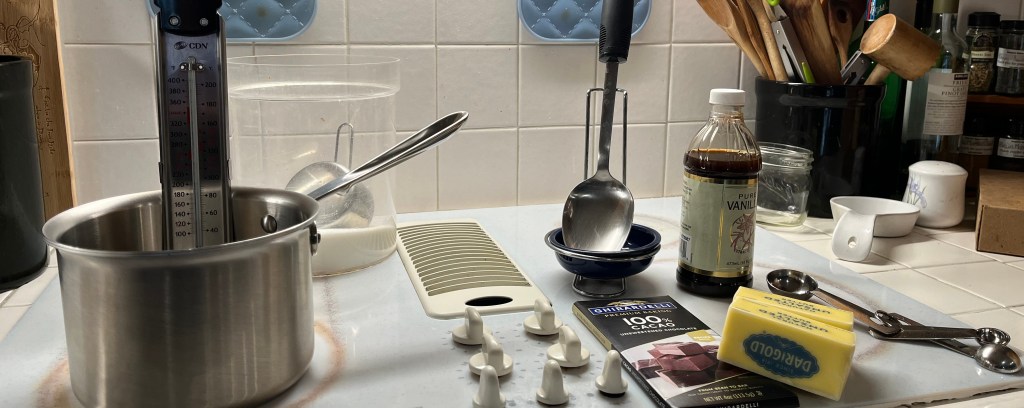
Finally, the epiphany came. This was a revelation about what was probably the clearest and least ambiguous instruction in the recipe. “In a heavy-bottomed 2-quart saucepan…” Now bear with me. I had the heavy-bottomed part of the instruction cold. The part that had eluded me was 2-quart. I had just assumed that by 2-quart it meant 2-quart or larger. After all, if your pea recipe calls for a 2-quart saucepan, one could use a 3-quart saucepan with no deleterious effect. But when candying, nothing could be further from the truth. By 2-quart it means 2-quart, no more, no less. 2-quarts shall be the volume thou shalt use, and the number of the quarts shall be 2. It shall not be a 3-quart saucepan and 3½ quarts (which was what I had been using consistently) is right out. The reason for this exacting specificity goes back to the chemistry; the goal is to reduce the surface area of the fudge mixture that is exposed to the air while it is both cooking and cooling. Moreover, the taller and narrower pan ensures that the end of the candy thermometer is thoroughly submerged in the candy, delivering a more accurate reading during the delicate process.
Results improved immediately. For the first time since I began my quest, I was turning out reliably edible fudge while also getting a reasonably consistent crystallization. Now that I had conquered this main hurdle, I could focus on details such as heat. Heat had always been difficult to regulate on gas stove tops. Upon moving to Sequim, I was cooking once again on an electric range and had to adjust my technique to accommodate. It has now been a solid decade since I’ve burnt a batch. I’ve added additional tweaks that have further improved my results.
The product that I’m turning out today is a far cry from the hockey puck fudge of twenty-five years ago. Family, friends, and neighbors look forward to it every holiday season, and nobody need duck because a burnt saucepan is about to take flight. I’ve come a long way. Nevertheless, I still feel that I haven’t found Nirvana. The quality of Jesse and Belle’s fudge still eludes me. For the past two decades, I’ve worked with the same recipe, and in doing so have honed my technique. This year, I plan to make some changes to see if I can advance my game.
First, I plan to do some additional research into the chemistry of crystallization. I figure that the better I understand how the reactions work the better I will become at controlling the variables, particularly those environmental factors of temperature, humidity, and altitude.
Second, I plan to experiment with other recipes to see if I can capture more of the fairy-tale nature of Jesse and Belle’s fudge. “Joy of Cooking” is far from being the sole or even most reliable authority. Up until now I haven’t strayed because I didn’t want to introduce more than one new factor at a time. But the time has come to work with other recipes.
Third, I propose to communicate with local practitioners of the art. This gets complicated because many of the folks around here who profess to make fudge make the gooey variety. By way of texture, I consider their confections to be more of a caramel than fudge. But this is a region of retirees and surely there are folks hereabouts that make crystalized fudge. Now that my own fudge is reliably not an embarrassment, it’s time to seek a guru.
Finally, I desire to find at least one young person, preferably from inside my family, to whom I can impart my fudge making art. This is essential family lore that should be passed down to future generations. After all, it would be nonsensical to have done all this work to recover the lost secrets of Miss Jesse and Miss Belle, only to lose them again by taking them to the grave myself, right?
What is your Nirvana quest? Do you have a childhood memory that you’re tried to recover as an adult?
 Erica and Friends
My family had an upheaval when I was around twelve years old. My dad, home from Viet Nam, relocated us minus my mom, to Southern California. He was chasing a newfound love and life. We were pale fish out of water. My Granny Belle bravely made the trip. Her peanut butter cookies were a gift of love and comfort in very trying times. I’ve never perfected the recipe, but I’m happy trying. She couldn’t fix what was wrong, but she could show her love in the best cookie I’ve ever had. My recipes are missing her constant devotion.
LikeLiked by 1 person
I adore your use of the word “devotion” as an ingredient in Granny Belle’s cooking. Thank you for sharing!!!
LikeLike