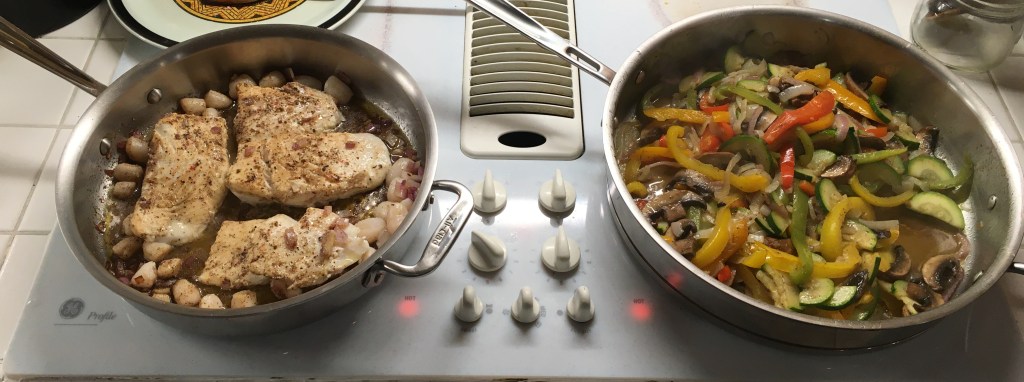
Remember the old joke about being on a Seafood Diet? The punchline is, “I see food and I eat it” Well, one might say that I see food and make it. My long-suffering beloved spouse thinks I spend too much time in the kitchen. I’d spend much more time there if I had the time. Let me explain.
When I was young, dinnertime was a ritual. The five of us sat together at table every night and shared the events of the day, discussed the news, or plotted the schedule for the next day. The food on the table, unfortunately, was irrelevant. Mom was an adequate cook who could prepare meals on a sparse budget that satisfied the demands of hunger and nutrition. Hard stop. Food was there because it had to be, but Mom detested preparing it. Moreover, the flavor palate was straight out of the 1950s obsession for food that was overcooked and under seasoned.
A word in Mom’s defense. Her mother, a single mom, had to work and did not have time either for cooking or for passing those skills along to her daughter. When my mom married, it was the early 1950’s and all women were expected to be able to sew and cook and manage the home. Mom didn’t have some of those skills initially. Instead, she was flung into the ocean and expected to swim. She managed, to her very considerable credit, to assemble something of a life raft from the flotsam and jetsam of existence to keep us afloat as a family.
Like her mother, Mom didn’t invest in teaching her offspring to cook. Given the convenience and availability of packaged foods with instructions right on the outside, she probably didn’t see the point. Consequently, when I left home after my junior year of college, I didn’t know my way around the kitchen. We threw together a box with a couple of pans, a plate, a few utensils, and a copy of “The Better Homes and Gardens Cookbook” (BHG). I was on my own.
That first year was tough. I spent most of it living on the second floor of a rooming house. The kitchen (so-called) consisted of a tiny gas stove outfitted illegally in the basement of the building, which was accessed by a dark stairway in the rear. The sink was literally a laundry sink. I subsisted primarily on bananas for breakfast and hot dogs boiled in canned vegetable soup for dinner. It was pathetic and disgusting. My epiphany came one weekend when I had allowed my breakfast bananas to become too ripe. Someone at school suggested banana nut bread, and sure enough there was a recipe in BHG. I bought the ingredients along with a cheap aluminum bread pan and gave it a try in the wretched gas oven. Success!! It was delicious and every bit as good as just about anything Mom had ever made. Serving myself a slice of that bread as dessert following my hot dog soup was an event. It was a reward. It was a blessing. I vowed that it would not be an isolated experience.
A few months later, I moved into an apartment with a friend from school. The apartment had a genuine kitchen and both of us thrived on preparing meals. We rarely ate together, but when we did, we made an occasion of it. More important, as my skill in the kitchen increased, so did the breadth of my repertoire of recipes and ingredients. I remember the first time I cooked with fresh mushrooms. I had only ever had them out of a can, small and rubbery. Yuk! Suddenly an entirely new world opened to me. Not long after that, I was planning a dinner party and it occurred to me to serve wine. There was a wine merchant in the neighborhood and knowing nothing about wines I went in and asked questions. Thirty minutes later I emerged with two bottles of a French red from the Graves region. Perfection! I had discovered pairing wine with food.
The beloved and I have been together for more than forty years now, and it continues to get better and better. While we were raising the children, mealtime was sacrosanct just as it had been in my youth, but now food played a role at the table. We did the majority of our cooking from scratch even in those days, pulling frequently from BHG. We took pride in taking something as mundane as a chicken and finding new and wonderful ways to prepare it. We invited discussion as to what worked or didn’t and why. Even leftovers could be served as something special or unique.
Holidays took on an even more important role in the kitchen. When the children were young, we had evolved a practice of inviting our “adult orphan” friends to holiday meals. Simultaneously, we were evolving a more complex menu for these gatherings. Christmas dinner, for example, was roast prime rib of beef with Yorkshire pudding. When we added in French onion soup, we began planning the meals in courses. Wine pairings became more complex and adventuresome. Between courses, conversation could continue on until broken by the next course. Then for a few minutes guests could focus on a new flavor and texture experience.
We carried these traditions to Sequim when we moved (along with the increasingly decrepit BHG) and have expanded on them since. Entertaining increased, curtailed only by the pandemic. The repertoire has swelled almost exponentially as I’ve delved into the offerings and techniques of various international cuisines. My ultimate conquest of fudge will appear in its own separate piece. Produce grown on the property (along with a plethora of fine local wine makers) has propelled us into the intricacies of charcuterie. (Were you aware that there are no English language cookbooks on confitures available at present?) Why, even yesterday I prepared a tweak of my oven-fried Creole chicken and the beloved tried out a new recipe for roasted mixed vegetables. What a reward!
Food is more than mere nutrition. As a human activity, the preparation of food is a sharing of the produce of both earth and soul in a meaningful manner. It’s a way to bring people together and explore differences while partaking of a common good. It’s a fundamental act that nourishes the spirit as well as the body. The preparation and service of a carefully planned meal has a ritualistic essence that makes every dinner special if you allow yourself to inhabit it. At the end of a day, meal preparation is a joy.
I am gratified that all three of my children have left home being adept in the kitchen, and each of them continues to explore their own culinary universe. When they come to visit, I can point any of them to a kitchen task and not have to worry. And then they return the favor. On his last visit, our eldest prepared the latest version of his miraculous chili. I’ve never tasted anything so wonderful.
One last word about Mom. Mom had two or three fabulous meals upon which she lavished genuine attention, and these were on the “most requested” lists for birthdays. Fried chicken and barbecued pork ribs were among them. I spent many years perfecting both my fried chicken and barbecued ribs recipes. Now, fried chicken is the most requested birthday meal in my house, at least when one of the children is going to be here. The barbecued ribs, however, are the special province of my own birthday, and I no longer trust them to anyone else to prepare. Mom set the bar impossibly high, but I’ve finally met that challenge.
One more thing. Despite shelves of cookbooks and recipe binders, we still draw heavily on the ancient BHG. This is truly from scratch cooking, and some of the best there is. Thank you, Mom!!
What are your special food traditions? How does the ritual of food preparation inform your relationships?


My late wife taught me how to expand my then-Canadian repertoire to include most of her Jamaican meals. Preparing meals like salt fish and ackee for my kids is my way of extending her love to them.
LikeLike
What a beautiful thought. This is a wonderful example of the act of preparing and serving food transcending a passing. Thank you for this insightful extension.
LikeLike