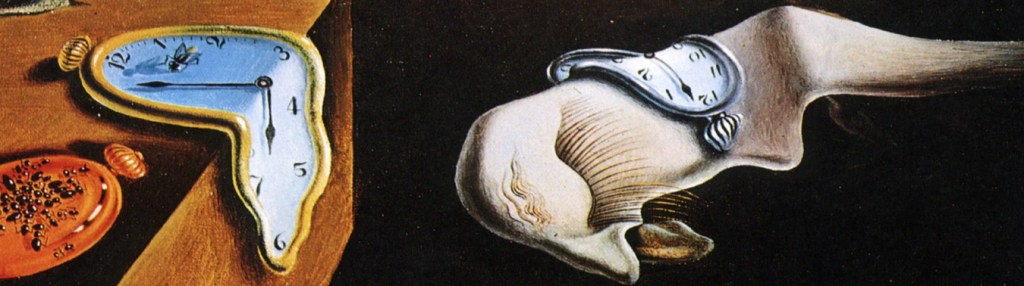
The tenth Dr. Who (in the episode ‘Blink’) offered the following insight: “People assume that time is a strict progression of cause to effect but actually from a non-linear non-subjective viewpoint it’s more like a big ball of wibbly wobbly time-y wimey…stuff.” [Dr. Who]
When I was young, time was a volatile chaos. I think I spent most of my time waiting for events that, when they finally arrived, were gone in a blink. It took a year to live through the school week only to have the weekends pass by in minutes. Waiting for the school year to end and summer vacation to begin took longer than a Galápagos tortoise growing from egg to old age. Summer was consumed faster than a strawberry milkshake. The longest wait of all was for Christmas. Three hundred and sixty-four days stretched before me every December 26th like the vast expanse of the Mesoproterozoic era; the wait itself passed with the speed of frozen molasses. Christmas day was the shortest increment of time known to mankind. Decades later, the term nanosecond came into use to describe the span of that venerable holiday.
My parents, of course, no longer experienced time this way but I had no way to know it. I didn’t feel the pressure of finding time to prepare meals or wash clothes or shop for groceries or buy this year’s back-to-school wardrobe. I didn’t have to squeeze in making lunches or driving my sick child home from school. I wasn’t faced with the pressure of earning a living sufficient to cover most of the cost of raising three children, much less the stress of raising them. When Christmas season came, I was oblivious to the effort that went into shopping, wrapping presents, decorating the house, planning the dinner menus, writing and mailing Christmas cards, and all the myriad other things that made the day so magical. And so fleeting.
By the time I was in graduate school, everything had changed. Time had turned in upon itself and in so doing must have created a rupture somewhere, for time was disappearing at a terrifying rate. I’d been taught as a child that there were precisely twenty-four hours in a day, each of which was divided into exactly sixty minutes of sixty seconds each. That’s twenty-four hours or 1,440 minutes or 86,400 seconds to splash around in every single day. I could arrange them however I chose. In graduate school I discovered this to be nothing less than a preposterous myth. Clearly there were fewer than twenty-four hours in a day. Not only that, the number of minutes in an hour varied from hour to hour. The only remaining consistency was that there were universally fewer than sixty of them. I won’t even attempt to describe my relationship with seconds because therein lies madness. Suffice it to say that I defined the appearance of the next lowering term paper deadline in that increment of time.
Suddenly I was a parent, pressured to prepare meals or shop for groceries or drive children to and from school. I had deadlines to meet both at home and at work. On top of that, I had to travel for work which further sliced time into unrecognizable shapes and inconsistent increments. Now I was the one having to add in all the things needed every December to bring Christmas to a family of five. It was fun and exciting, but time had long ceased to be a cooperative partner in my life. This recognition came with a disconcerting revelation: I had become my parents.
I wish to step back for a moment to recognize a heroic group of people: single parents. For over forty years now I have been blessed with a life partner and soul mate and we have traveled the road of life and parenthood together that entire time. Children don’t come with owner’s manuals, so we’ve encountered some rocky times over the years. Nevertheless, between the two of us we have been able to wrangle time into near submission without damage to the progeny. I do not know how single parents are able to cope with only half of the available time. You have my profoundest admiration and I offer each of you a hug.
As I approached retirement age, I began to speculate on time and how I would use it. I pictured myself being, for the first time in my existence on this planet, in control of my time and materials. I would cease to be tied to an employer’s deadline or a child’s minimal daily requirements. A week would return to consisting of seven equal days of precisely twenty-four hours each and I would be master of every one of them. I envisioned a new level of productivity wherein I could set aside blocks of time each day for value-add activities. Time management utopia was practically close enough to touch.
I was to be profoundly disappointed. In all my envisioning, in all my planning, and in all my blue-sky diagramming, I had left out the most important factor to be considered, the factor that drives everything. It was as if I had planned an elaborate dinner party around a handcrafted bouillabaisse and had neglected to consult the local fish monger. I hadn’t factored myself into the equation.
Retirement came suddenly and early. It also arrived two months before the world shut down due to the global pandemic. When my contract was abruptly cancelled that January, I was only eleven months from my planned retirement. I looked at the calendar and saw no value in trying to find another client for so short a time. Besides, only weeks earlier I had been recruited as Music Director for a show that needed “saving.” Now I would be able to dig in and do the work necessary to be successful in that role. The show was a success and closed just days before the state closed all gatherings down.
The first four months of social distancing were terrific. I worked around the property, dabbled in several projects on my to do list, and reveled in the abundance of time. After a while, I began to yearn for collaborative effort again. I hit on the idea to produce a socially distanced music theatre review which occupied me for nearly six months. By then other projects had presented themselves, taking available time and stretching it very thin.
That’s where I find myself today. Every moment seems to race by in a stampede of seconds. Each day rips past like pages torn from the book of life by Mr. Dark.[1] Nights of insomnia are the sole exception. Sometimes I contemplate what it would be like to be chums with a time lord, or maybe to be attached to a pooka.[2] Alas, each of those comes with a price so I think I shall pass. My time is filled with things I love to do. Because my interests are so broad, however, I must prioritize stringently to survive. You know what, though? It’s a lovely problem to have.
[1] Ray Bradbury “Something Wicked This Way Comes” [Jonathan Pryce as Mr. Dark]
[2] Pooka: a creature from Celtic folklore considered at times to bring either good fortune or bad. In some legends, they have the capability to manipulate time for their human charge.
What is your perception of time? Do you experience it in different lengths? Do you have specific time management practices?
 Erica and Friends